Everything Speak AI detects in a recording, sentiment, keywords, brands, locations, themes and your own custom categories, can leave the account. Pull it into a spreadsheet for a one-off analysis, push it into Tableau or Salesforce, or wire it into another app so it arrives without anyone clicking Export. This page covers all three routes.
Include insights in a CSV export
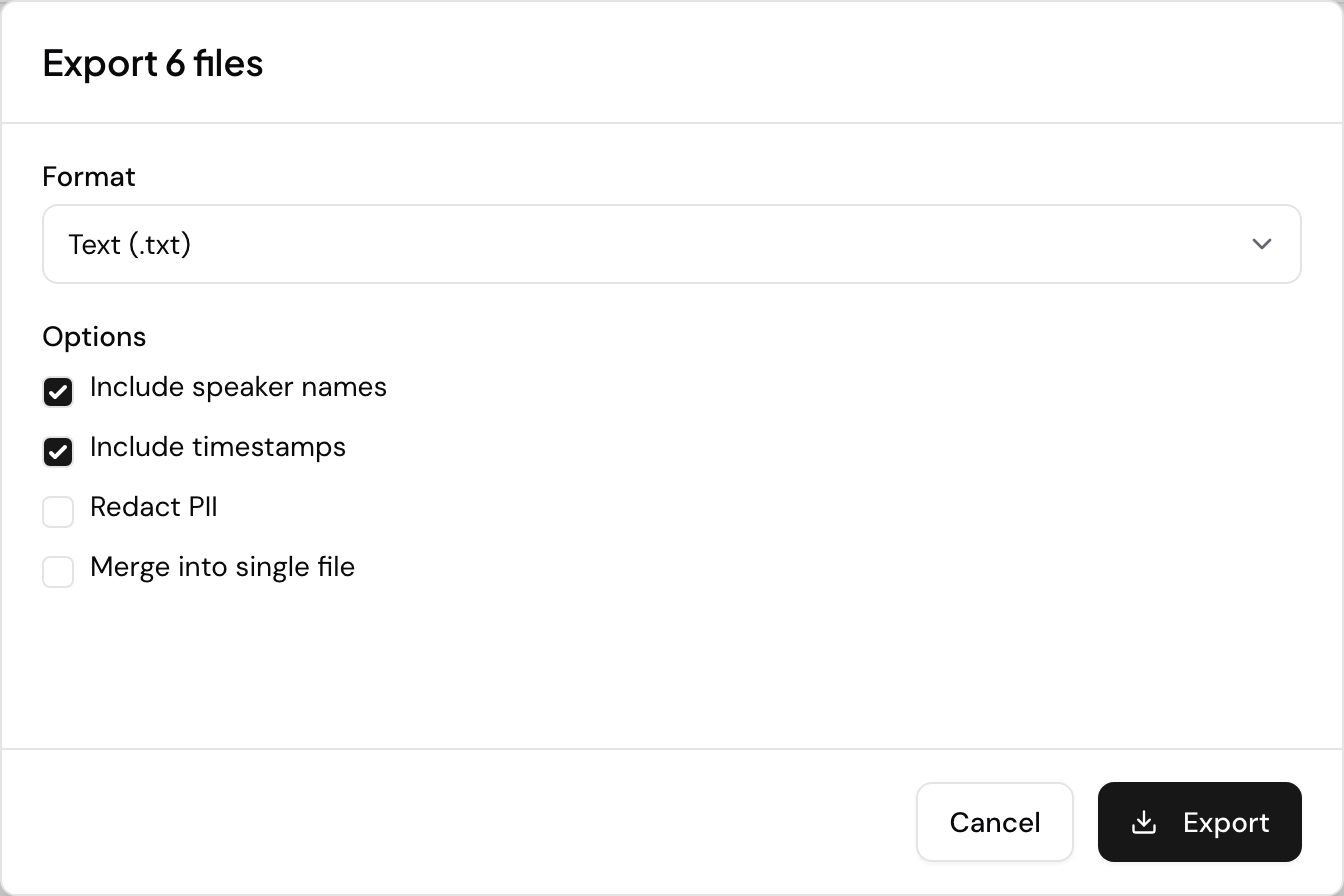
Insights ride along with a normal export. Open a media file or a folder, click Export, and choose CSV. There is no checkbox to tick: if the file has been analyzed and insights exist, they are in the download.
The CSV carries an Insight Category column and an Insight column. Each detected insight gets
its own row, so a single recording produces one row per keyword, brand, location, or custom
category value. Choose CSV rather than a document format whenever you want that full breakdown,
because PDF and Word exports summarize the insights instead of listing every occurrence.
Two things to check when a CSV comes back thinner than you expected:
- The file has finished analysis. Insights only appear in the export once they have been generated. See transcription status if a file is still processing.
- You picked CSV and not one of the document formats. Format options and what each one includes are listed under transcripts.
If you want a plain list of keywords with no timestamps or row-per-occurrence detail, download the word cloud data instead, or copy the list straight from the Insights tab.
Export dashboard widgets
Dashboard widgets that hold tabular data have their own Export CSV action in the widget header menu. That is the route to take when you want the numbers behind a chart rather than the raw insight rows for a set of files. See dashboards for which widget types support it.
Send insight data to other apps with Zapier
Zapier moves insight data out of Speak AI on its own, with no export step. Use the New Media Processed trigger to fire on each finished file, or the New AI Chat Response trigger when you want structured output from a prompt rather than the raw insights. Pair either one with an action such as creating a row in Google Sheets or updating a HubSpot contact.
For structured fields like action items or contact names, set up an automation in Speak AI first so the prompt runs on every new file, then use the AI Chat response trigger to collect the result. Full setup steps and the list of supported triggers are on the Zapier page.
If a working Zap suddenly stops, check whether your Speak AI API key has been regenerated. Regenerating the key breaks the existing Zapier connection, and you need to reconnect the account in Zapier with the new key.
Pull insight data from the API
The API returns the most detailed version of the data, including word-level timestamps that CSV
exports aggregate away. Call GET /media/insight/{mediaId} to read the insights for a processed
file, and poll GET /media/status/{mediaId} to know when a file is ready. Both endpoints, along
with the response shape, are documented in the media API reference.
Want a hand setting this up? Book a free consult and we’ll do it together on your account.
Related: Exports · Transcripts